Let’s Talk Money: The Business of Being An Author (Part 1)

The other day I watched an author on YouTube. She was sharing how much money she earned in 2025 (as her cats pranced in and out of the shot).
I watched until the end—not because I'm a sucker for cats or I cared how much this woman earned.
It was interesting to see a writer talk about their actual numbers. Getting insights into the business of writing is rare.
A traditionally published author has almost no idea what's happening in their writing business because... well, they don't really have a business. The publisher has a business.
An indie author, on the other hand, has great visibility into what's happening. But without an MBA, navigating various dashboards, platforms, pricing, and engagement metrics can make it nearly impossible to understand and make data-driven decisions.
Somehow, I did actually earn an MBA from a prestigious business school (likely having a down year when they accepted me).
I've been evaluating my numbers and my writing trajectory. I've made some changes to my self-publishing strategy and I thought you might want to understand my thought process.
Over the next four weeks, I'll tell you what's happening under the hood of my business—sharing my own numbers.
Might be interesting, right?
Let's start with something juicy.
How much money do I make when someone buys my book?
Like everything in life, the answer is... it depends. In this case, it depends upon the format and the place where it's sold.
Average retail prices by format: Audiobook $21, Paperback $18, Hardcover $27, Ebook $6.50 (ebook profit includes a significant volume sold at discount).
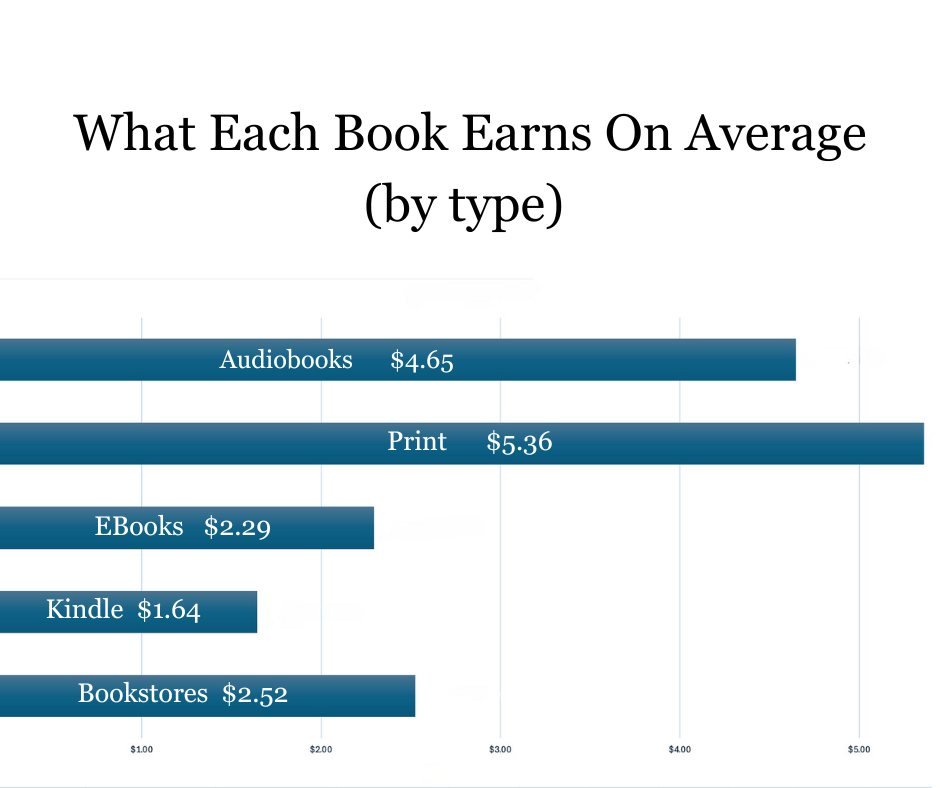
Amazon Print ($5.36) Amazon takes about 40% off the top after they charge for printing. I get what's left.
Audiobooks ($4.65) Audible prices my audiobook around $21 and lets me keep 40%—if I'm exclusive. Amazon royalty math says 40% of $21 is less than five bucks. Go figure.
Bookstores ($2.52) The bookstore gets 55% of the retail price. Keep in mind they pay for shipping, inventory, and employees (in other words, they're not taking home 55%).
Now, just looking at dollars, you'd think I'd rather sell print through Amazon than through bookstores, right? Hold that thought.
Ebooks ($2.29) No printing, no shipping, pure digital. Amazon still takes a sizable chunk.
Kindle Unlimited ($1.64) I get paid less than half a cent every time an index finger sweeps right on an iPad. It adds up. Slowly.
Do those numbers surprise you? Maybe a bit meager for the amount of time it takes to write a novel? You'd get no argument from me.
Alright, so what's the takeaway from a guy with an MBA who, in another life, got paid real money for consulting on growth strategy?
In evaluating a business, I start with a question…
Does it have a moat?
Yup. I'm talking about that alligator infested stagnant water around a castle. Back in the day, any king worth his mutton had a good moat.
The same should be true for writers impersonating businesspeople.
So based on what I've shared about my business, what are the odds I can effectively defend my castle?
If you guessed "low," you're right.
My drawbridge is unzipped and there's a sign that says, "Please wipe your feet before pillaging."
Why?
Because all my eggs are in one basket. And that basket is being swung around by a very large company named after a massive river with poisonous snakes and piranhas.
Amazon doesn't give a shit about my eggs.
This is a key insight that I'll discuss in more depth.
Over the next four weeks, you'll have a pretty clear idea about what's under the hood of my writing business and the decisions I'm making to keep the engine running.
In Part 2 next week, I'll share how my author income is distributed.
Live Long and Prosper,
Andy